Important Links
Important Note: The donation button links to the official donation page of the Temple Trust. Sanatan Vasudev Kutumb has no affiliation with the temple or the donation process.
We pray that your wishes find the Almighty’s grace, and that you and your loved ones are always blessed, guided, and protected.

Banke Bihari Temple (Vrindavan, Uttar Pradesh)
Information on this page
Important Note: The donation button links to the official donation page of the Temple Trust. Sanatan Vasudev Kutumb has no affiliation with the temple or the donation process.
We pray that your wishes find the Almighty’s grace, and that you and your loved ones are always blessed, guided, and protected.
Overview
The Banke Bihari Temple Vrindavan Uttar Pradesh is one of the most enchanting and spiritually charged temples in India, dedicated to Lord Krishna in his most playful form as Banke Bihari Ji. Located in the sacred land of Vrindavan, this temple captures the essence of devotion and love between Krishna and his devotees. The name Banke Bihari translates to “the Supreme Enjoyer in a Tribent Posture,” depicting Krishna with one leg bent and a flute in hand – an image that radiates divine charm and joy.
History of Banke Bihari Temple (Vrindavan, Uttar Pradesh)
The history of Banke Bihari Temple dates back to the 16th century, when the saint Swami Haridas Ji, a great devotee of Lord Krishna and guru to Tansen, discovered the idol of Banke Bihari in Nidhivan, Vrindavan. According to legend, the deity appeared before Haridas Ji and his disciples as a combined manifestation of Radha and Krishna. Moved by the divine vision, Swami Haridas Ji requested the Lord to remain in the form of Banke Bihari for all to worship. The temple was later established by Haridas Ji’s disciples to preserve this miraculous form and has since become one of the famous temples in Vrindavan.
Architecture & Design
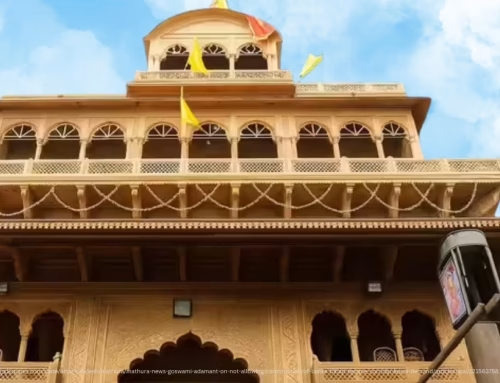
The Banke Bihari Temple is a stunning example of Rajasthani architectural style, blending vibrant artistry with devotional aesthetics. Built mainly of red sandstone, the temple features intricately carved arches, floral motifs, and beautifully engraved jharokhas (windows). The sanctum sanctorum houses the black idol of Banke Bihari Ji, dressed daily in exquisite silks and ornaments that change according to the season.
Unlike most temples, bells or conch shells are not used during worship – the atmosphere is filled instead with soft devotional songs (bhajans), creating an intimate spiritual connection.
Religious Significance
Banke Bihari Ji is considered the personification of Madhurya Bhava – the sweetest and most personal relationship between devotee and deity. The temple’s unique darshan tradition emphasizes this intimacy: the curtains in front of the idol open and close repeatedly to protect devotees from being overwhelmed by the magnetic gaze of the Lord. It is said that anyone who looks at him continuously might lose consciousness in divine ecstasy.
Festivals & Rituals – Banke Bihari Temple (Vrindavan, Uttar Pradesh)
The Banke Bihari Temple Vrindavan Uttar Pradesh is the center of major Vaishnavite celebrations:
- Janmashtami (August) – Celebrating the birth of Lord Krishna with midnight prayers and joyous chants.
- Holi (March) – The temple becomes a riot of colors, with priests playfully sprinkling colors and flowers on devotees.
- Jhulan Yatra (July–August) – The idol of Banke Bihari Ji is placed on a beautifully decorated swing, symbolizing Krishna’s playfulness.
- Sharad Purnima (October) – The deity is adorned in pure white garments under moonlight, symbolizing purity and divine love.
- Diwali & Annakut (October–November) – A grand offering of sweets and food is presented to the Lord after Diwali celebrations.
Annual Events & Festival Calendar
| Month | Festival / Event | Description |
|---|---|---|
| January | Vasant Panchami | Temple decorated with yellow flowers; special aarti held. |
| March | Holi | Celebration of colors and bhajans in Krishna’s divine spirit. |
| July – August | Jhulan Yatra | Deity placed on swings with floral decorations. |
| August | Janmashtami | Midnight rituals celebrating Lord Krishna’s birth. |
| October | Sharad Purnima | Night-long devotional singing and darshan. |
| October – November | Diwali & Annakut | Temple illuminated; offerings of sweets to Lord. |
Cultural Practices
Visitors to the Vrindavan Krishna Temple experience a culture of love and devotion unlike any other. The temple has no bells, emphasizing silent prayer and inner connection. Devotees chant “Radhe Radhe” – invoking both Radha and Krishna’s names – as they enter. During Seva (service), devotees offer Makhan Mishri (butter and sugar), symbolizing Krishna’s childhood fondness for butter.
Modern Updates & Facilities
- Online Banke Bihari Temple darshan and donation facility available
- Regulated crowd management during Janmashtami and Holi
- Upgraded queue systems and CCTV monitoring
- Designated cloakroom and footwear stands outside temple premises
- Support for elderly and differently-abled devotees during festive seasons
Visitor Information
- Banke Bihari Temple timings:
- Summer: 7:45 AM – 12:00 PM | 5:30 PM – 9:30 PM
- Winter: 8:45 AM – 12:00 PM | 4:30 PM – 8:30 PM
- Aarti timings: Vary according to season and festival
- Dress code: Traditional attire recommended
- Photography: Prohibited inside the sanctum
How to Reach Banke Bihari Temple (Vrindavan, Uttar Pradesh)
- By Air: Nearest airport – Agra (77 km) or Delhi (160 km)
- By Train: Mathura Junction (12 km from temple)
- By Road: Well-connected from Delhi, Agra, and Noida via NH-19
Nearby Attractions
- Prem Mandir – Marble wonder depicting Krishna’s life scenes
- ISKCON Temple Vrindavan – Hub for international devotees
- Nidhivan – Believed to be Krishna’s nightly dance ground
- Radha Raman Temple – Another famous Vaishnavite shrine in Vrindavan
Interesting Facts
- The temple remains closed during Mangala Aarti, as devotees believe Krishna was a late riser as a child.
- The idol was once hidden during Mughal invasions and later reinstalled in the current temple.
- Unlike other temples, the deity is never awakened early — there is no Mangala Aarti in Vrindavan.
- The darshan pattern of opening and closing curtains was introduced by Swami Haridas Ji himself.
- During Seva, the priests lovingly fan the Lord and offer him sweets as though serving a living being.
Conclusion
The Banke Bihari Temple Vrindavan Uttar Pradesh is not just a sacred shrine but the living heartbeat of Vrindavan’s spiritual rhythm. Every visit offers devotees a glimpse of Krishna’s boundless love and divine charm. Its unique darshan system, soulful bhajans, and vibrant festivals make it one of the most enchanting Vrindavan Krishna temples – where devotion feels alive in every sound, scent, and smile.